Most operators in Nepal pick a GPS provider based on monthly cost and how the dashboard looks during the sales demo. Both matter. Neither is what determines whether the system actually works the day you need it most.
The day you need it most is usually the day something has gone wrong. A vehicle in an accident on the Prithvi Highway. A driver disputing a route claim. An insurance company asking for trip history from six months ago. A DoTM auditor asking why your speed logs are missing. By the time those moments arrive, switching providers is no longer an easy option.
NepTrack was built specifically for Nepali fleet conditions, after the team spent years watching foreign-built GPS systems fail on local roads, in local hills, and against local regulatory needs. What follows is the checklist we wish operators had been given before they bought their current systems.
1. Where is your data actually stored
Ask your provider this question directly: which country are the servers in.
Most GPS platforms operating in Nepal route data through servers in India, Singapore, or the Netherlands. Your vehicle's live location, your driver's behaviour records, your route history, all of it sits on infrastructure outside Nepal's jurisdiction. If a regulatory body or court requests that data, the request goes through foreign legal processes. That can take months.
For public transport operators, the upcoming DoTM compliance framework is expected to require Nepal-hosted infrastructure. Buying a foreign-routed system today means replacing it later.
2. How long do they keep your trip history
Many GPS platforms retain data for thirty to ninety days, then either delete it or charge extra to access older records.
For Nepali operators, this matters in three specific ways: insurance claims often take longer than ninety days to investigate, accident litigation in Nepal can stretch across years, and DoTM audits may require historical compliance evidence going back multiple seasons.
Five years of immutable trip history should be the minimum standard. Anything less and you are buying a tool that fails you exactly when you need it most. See our breakdown on GPS tracker price in Nepal in 2026 for how data retention is often hidden in monthly pricing.
3. What happens when GPS signal drops in the hills
This is the test foreign-built platforms fail most often.
Nepal's geography is not flat. Routes through Mugling, Sindhupalchok, the Karnali corridor, anywhere with steep cliffs or dense valleys, will lose GPS satellite signal regularly. A platform that only knows how to read GPS will show your vehicle as stationary or missing for fifteen, twenty, sometimes forty minutes at a stretch.
The fix is something called LBS fallback. The system uses cellular tower data to estimate vehicle position when GPS is unavailable. Less precise than satellite GPS but it keeps the vehicle on the map. Ask your provider whether they support LBS fallback. If they do not know what that means, that tells you everything. We covered this gap in more detail in our piece on how GPS tracking reduces road accidents in Nepal, where remote-area signal handling can be the difference between a fast emergency response and no response at all.
4. Bikram Sambat (BS) reports and a Nepali interface, not as add-ons
This sounds like a small thing. It is not.
If your fleet is regulated by DoTM, audited by a Nepali accountant, or you report to a board that thinks in BS dates, every AD-format report you generate has to be converted manually. Multiply that across thirty vehicles, weekly reports, monthly summaries, and you have hours of unnecessary work plus the inevitable conversion errors.
Reports should be available in Bikram Sambat (BS) natively. The dashboard, the alerts, the driver app, and the support documentation should all exist in Nepali. Half-translated interfaces are common in this market and they create more problems than they solve. Your dispatch team and operations staff are usually more comfortable working in Nepali than English. A platform that forces them into English-only software either limits who can use it or adds training costs you did not budget for.
5. Which device brand sits on the vehicle, and is it actually compatible with the platform
This is the part of the conversation salesmen avoid.
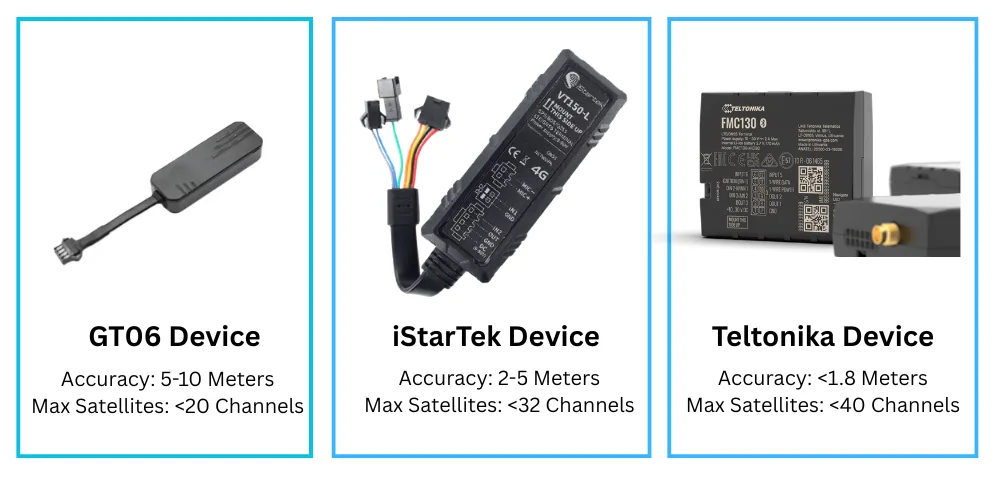
The most common GPS device installed on Nepali vehicles today is some variant of the GT06 family, cheap Chinese hardware imported in bulk and rebadged by dozens of local vendors. The unit cost is low, which is why so many providers default to it. The data quality is also low. GT06 devices send sparse location updates, lack proper G-sensor crash detection, have limited input-output capability, drop connections frequently, and tend to fail within twelve to eighteen months in the heat and dust of Nepali road conditions.
If your provider cannot tell you the exact device model, manufacturer, and firmware version they are installing, that is the first warning sign.
The brands that serious fleet operators rely on globally are iStartek for reliable mid-tier deployments and Teltonika for high-end commercial fleets. Teltonika devices in particular are the industry standard for accident detection, driver behaviour analysis, fuel monitoring, and external sensor integration. They cost more upfront. They also last three to five times longer, transmit cleaner data, and support the kind of advanced telemetry that makes driver behaviour and crash detection actually work. For fleets where fuel theft and consumption monitoring matter, the choice of device also affects which sensors you can use, as covered in our guide on the best fuel sensor for trucks in Nepal.
Ask your provider two specific questions. First, which device models do they install, and can they show you the spec sheet. Second, is their platform compatible with multiple device brands or is it locked to one cheap supplier. A platform that only works with GT06 hardware will limit what you can do later, even if you are willing to pay for better devices. NepTrack is fully compatible with GT06 for budget deployments where that is the right choice, iStartek across the mid range, and the full Teltonika range for premium and commercial fleets. The platform reads each device at the protocol level so you are not locked into one hardware tier.
6. Driver behaviour monitoring and crash detection that actually works
A GPS device that only shows where the vehicle is, is barely a GPS device. The real value sits in what the platform does with the data.
Driver behaviour monitoring covers harsh acceleration, harsh braking, sharp cornering, speeding against route limits, idling beyond a threshold, and distance-based fatigue alerts. These are the patterns that predict accidents before they happen and the metrics that let you have honest conversations with drivers about how they are operating your vehicles. Insurance providers in Nepal are slowly beginning to factor this into premium calculations. The full ROI picture for measuring driver behaviour is covered in our article on how logistics and transport companies in Nepal can save fuel with GPS tracking.
Accident detection is a separate capability. The device detects sudden impact, abnormal deceleration, or rollover events using onboard sensors, then triggers an alert to a monitoring centre with the vehicle's last known coordinates. On highway routes through remote stretches, the gap between an accident occurring and someone finding out about it can be the difference between a recoverable injury and a fatal one. Ask your provider whether the device has G-sensor crash detection, what events trigger an alert, and what happens after the alert is generated.
If the answer is "the system records it and you can review it later," that is not crash detection. That is crash logging.
7. Does the platform actually help you grow the business, or just show a dot on the map
This is where most GPS providers in Nepal stop being useful.
You can see where your vehicles are. You can pull a trip report. That is it. The platform does nothing to help you earn more from those vehicles, expand into new revenue lines, or run services that customers will actually pay for.
A modern fleet platform should give you tools that turn tracked vehicles into business outcomes. Built-in QR ticketing for public transport routes, so collections and trip data are reconciled in one place. Vehicle rental management for operators running rental fleets, with bookings, customer profiles, and live tracking integrated. An ambulance finder layer for hospitals running emergency fleets, so the nearest available ambulance can be located and dispatched in seconds. Municipal garbage collection routing for city contracts. EV charging station management for operators entering the electric vehicle infrastructure business.
Ask any GPS provider what their platform offers beyond live tracking and trip history. If the answer is nothing, that platform will not grow with you when your business changes shape.
NepTrack covers all of these as integrated modules on the same platform. One login, one device set, one support team. The list of what is available is at NepTrack Features and the specific solutions for each fleet type are linked there.
8. Robustness, uptime, and what happens when your fleet grows past one thousand vehicles
This is the question almost no operator asks during the sales demo, and almost every operator wishes they had asked two years later.
A platform that handles thirty vehicles smoothly may completely choke at three hundred. A platform that runs three hundred may slow to a crawl at one thousand. The dashboard takes ten seconds to load. Geofence alerts arrive five minutes late. Reports time out before they generate. The provider tells you they are working on it and you spend the next year compensating for slow software.
Ask specifically: how many vehicles is the platform currently handling, what is the documented uptime over the last twelve months, and what is the geofence query response time when the system is at peak load. If we talk about NepTrack, it is engineered to handle three million plus vehicles concurrently with geofence queries returning in under five milliseconds. That headroom means the platform will not slow down as your fleet grows. The platform also exposes open API access for third-party integration and real-time data streaming, which is something no other GPS provider in Nepal currently offers, useful when you eventually want to plug fleet data into your own systems.
Beyond raw scale, ask about support. Your device stops transmitting on a Friday evening and the provider's support team is unreachable until Monday morning. Three days of blind operation on a vehicle that costs you thousands of rupees per day to run. A provider with Nepal-based support, working hours that include evenings and weekends, and a documented escalation process is what you actually need. A provider with a chatbot and a support email address is what most options on the market will give you.
What to do with this checklist
Print it. Take it to every GPS vendor meeting. Ask all eight questions before you ask about price.
If a provider cannot answer any of these clearly, they are either hiding something or they have not built the system properly. Both are reasons to walk away.
NepTrack was built specifically because the team kept watching Nepali fleet operators get sold tools that did not match how Nepal actually works. The platform is new, the company is new, but the answers to all eight questions above are designed in from day one. See how the platform handles each of these, look at how it applies to your public transport fleet or private fleet. For related reading on specific use cases, see our pieces on school bus safety and parent tracking, hospitals and ambulance dispatch with GPS tracking, and the DoTM draft GPS guidelines breakdown for operators.