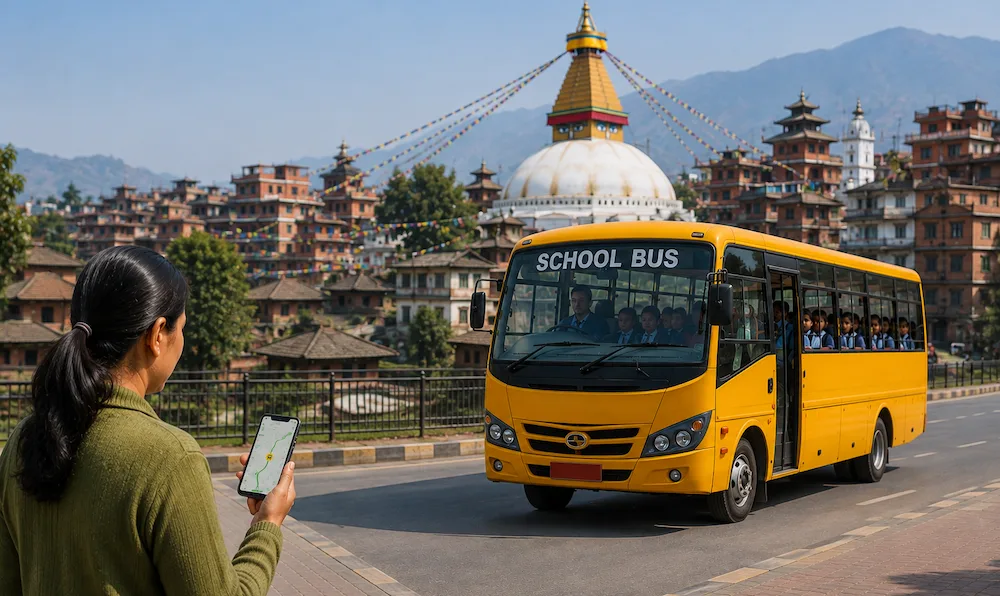
It is 7:40 in the morning. Your child left with the school bus twenty minutes ago, the rain has not let up since dawn, and the traffic on the ring road is already at a crawl. You check the clock again. Is the bus on the way? Is it stuck somewhere in Koteshwor? Did it even reach the next stop? Every parent in Nepal knows this quiet worry, and most of us have simply learned to live with it.
The truth is, for years the whole system ran on one number: the time the bus is supposed to arrive. If it usually comes at 7:10, you dress your child by 7:00 and wait at the gate by 7:08. When the bus is late, you stand there guessing, and a call to the school office usually returns the same answer, the office does not know either.
It does not have to work that way anymore. If your child's bus has a GPS tracker, you can open your phone and see exactly where it is, right now, on a live map, and know the minute it reaches your child's stop. This guide explains, in plain language, how parents in Nepal can track their child's school bus, what you will actually see, how to get started, and what to ask your school if it does not offer tracking yet.
Why tracking your child's school bus matters in Nepal
Nepal's roads are not forgiving. Kathmandu traffic can turn a fifteen minute route into forty. The monsoon floods underpasses and slows everything to a stop. Outside the valley, routes wind through hills where a substitute driver may not know every turn. In all of these situations, the parent is the last to know what is happening, even though it is their child on that bus.
Live tracking closes that gap. Instead of standing at the gate in the cold or the rain, guessing, you send your child out at the right moment because you can see the bus approaching. Instead of calling the school when the bus is ten minutes late, you already know it is stuck in traffic and still two stops away. It is a small change in technology that removes a large amount of daily stress.
How school bus tracking actually works
The idea is simple. A small GPS device is installed inside the bus. Every few seconds it records the bus location and sends it to a server. That data then reaches you in three ways:
- A live map on your phone that shows where the bus is right now
- An arrival time for your child's stop, updated as the bus moves
- Alerts that tell you when the bus is near, when your child boards, and if anything goes wrong
You do not need any special hardware. The device sits in the bus, and you use an ordinary Android or iPhone app. On a good system, you only ever see your own child's bus, never other routes or other children.
What you can see and do as a parent
A parent does not need a fleet dashboard full of charts. You need a few things to work reliably, every single morning and afternoon:
- Live location on a map that updates smoothly as the bus moves, without the icon jumping around the screen
- Accurate arrival time at your stop, so your child is not waiting outside longer than needed
- A pickup and drop alert, a notification the moment the bus is approaching your stop
- Board and alight confirmation, so you know your child actually got on in the morning and off in the afternoon
- Route deviation alerts, if the bus leaves its usual path
- Over-speed alerts, if the driver is going too fast
- An SOS or emergency signal that reaches the school and responders quickly
Those last two connect to something bigger than convenience. Speed alerts and a fast SOS emergency response are what turn a tracking app into a genuine safety tool, not just a moving dot on a map.
How to start tracking your child's bus, step by step
If your school already uses GPS tracking, getting set up usually takes a single afternoon:
- Ask the school if the bus has GPS tracking with a parent app. Many schools in Nepal already have it and simply have not told parents how to use it. The transport in-charge is the person to ask.
- Get your login or app. The school shares a parent app link and an account tied to your child. You download the app on Android or iPhone and sign in.
- Confirm your child and stop. Check that the correct route, stop, and pickup and drop timings are set for your child. This is what makes the arrival time and alerts accurate.
- Turn on notifications. Allow the app to send alerts, and choose the ones you want, bus approaching, boarding, and drop-off at minimum.
- Test it once. The next morning, watch the bus move on the live map and see whether the approaching alert arrives before the bus does. If something is off, tell the transport in-charge so they can adjust the stop or timing.
What to look for in a good school bus tracking system
Not all tracking is equal. If you are helping your school choose, or judging the app you already have, these are the things that separate a system parents actually trust from one they quietly stop opening:
- Smooth tracking with no jumping on the map. Cheap trackers make the bus icon leap across the map, which makes the arrival time useless. Good systems keep the movement smooth and the position accurate.
- Privacy by design. You should see only your own child's bus, never other routes or families.
- Reliable alerts. An approaching alert that arrives after the bus has already left is worse than no alert. Timing has to be dependable.
- Board and alight confirmation. Knowing your child boarded and got off is often the single most reassuring feature for a parent.
- Nepali language and Bikram Sambat dates. A system built for Nepal should speak the way Nepali families do.
- Works outside the valley. Hill routes have weak GPS signal, so the device should fall back to network-based location and keep reporting.
- Local support and data hosted in Nepal. When something needs fixing, you want a team you can reach, and your child's location data kept in the country.
- Aligned with the rules. Systems built around Nepal's transport regulations are more likely to stay compliant as rules tighten. You can read more on the DoTM compliance page.
Real mornings where tracking changes everything
The late bus. The bus normally arrives at 7:10. Today it is 7:18 and nothing. Without tracking, you call the school, get no answer, and keep your child waiting at the gate. With tracking, you glance at your phone, see the bus is caught in traffic near Balkhu and still six minutes away, and let your child finish breakfast indoors.
The route change. A substitute driver takes a wrong turn. On a basic setup, nobody notices until parents start calling. On a system with route deviation alerts, the school is notified the moment the bus leaves its path, and can call the driver before it becomes a problem.
The missed stop. On a busy morning, a child is not at the gate in time and the bus moves on. With board confirmation, you get an alert that your child did not board, so you know immediately instead of finding out hours later.
The emergency. In the rare case of a breakdown or accident, an SOS signal reaches the school and responders with the exact location, instead of precious minutes lost trying to describe where the bus is.
If your child's school does not have tracking yet
Many good schools in Nepal are still deciding. If yours has not adopted GPS tracking, you have more influence than you think. Raise it with the school administration, and ask two questions: can parents see the bus live, and will we be alerted when it reaches our stop. Those two questions push most schools in the right direction.
It also helps to hand the administration a clear picture of what a proper setup looks like from the school's side, including costs and the operations dashboard. Our companion guide on the school bus tracking page is written exactly for that conversation, and you are welcome to share it with your transport in-charge.
Frequently asked questions
Can I really see my child's school bus live on my phone in Nepal?
Yes. If the bus has a GPS device and your school uses a parent app, you open the app and see the bus moving on a live map in real time. On NepTrack, each parent sees only their own child's assigned bus.
Will I get a notification when the bus reaches my child's stop?
Yes. You can turn on an approaching alert that notifies you before the bus arrives, plus alerts when your child boards in the morning and gets off in the afternoon.
Does tracking work during monsoon or in areas with weak network?
Yes. NepTrack devices use GPS with a network-based fallback for weak-signal areas common in Nepal's hills, and they store location data locally during a temporary outage, then send it once the connection returns, so nothing is lost.
Is GPS tracking on school buses required by law in Nepal?
Long-distance public buses already fall under a GPS requirement as of January 2026, and the Department of Transport Management's draft guidelines propose extending GPS and CCTV requirements across public transport. School buses are not yet explicitly mandated, but many schools are adopting tracking ahead of the rule because parents now expect it.
Can other parents see my child or our location?
No. A properly built system restricts each parent to their own child's bus only. Other families cannot see your child, your stop, or your route.
How accurate is the arrival time?
On a good system with smooth tracking, the arrival estimate updates continuously as the bus moves and is accurate to a few minutes. Poor trackers that jump on the map produce unreliable times, which is why smooth, accurate tracking matters so much.
What should I do if my school does not offer this yet?
Raise it with the administration and ask whether parents can track the bus live and receive stop alerts. You can share the school-focused guide linked above to help them evaluate options.
The honest takeaway
Tracking your child's school bus is no longer a luxury or a gadget. It is a simple way to replace a daily worry with a glance at your phone. You see the bus, you know the arrival time, you get an alert when your child boards and gets off, and you have a real safety signal if anything goes wrong.
If your school already uses NepTrack, ask your transport in-charge for the parent app and follow the five steps above. If it does not yet, start the conversation, the technology is ready, affordable, and built for Nepal's roads. To see how it works or to help your school get set up, reach us through the contact page or explore the school bus tracking page.