Ask five GPS providers in Nepal for a price and you will get five different answers. Most will not even put a number in writing until you share your phone, your address, and sometimes your vehicle registration. The numbers, when they finally arrive, usually start somewhere around NPR 7,500 and climb as far as NPR 25,000 or more, with very little explanation of why one quote sits at the bottom of the range and another sits at the top.
This guide does the opposite of that. We break down every cost layer for 2026, with real ranges, real reasons, and the hidden fees that quietly inflate the final invoice. By the end you will know exactly what you are paying for, what is fair, and what is a sales gimmick.
The three things you actually pay for
People talk about GPS tracker price as if it is one number. It is not. A real installation in Nepal has up to four separate cost components, and any quote that lumps them together is hiding something.
- The GPS device hardware, paid once.
- A subscription or data service, paid annually or monthly.
- Installation, paid once, sometimes free.
- External sensors and accessories such as fuel sensors, temperature probes, RFID readers, or dashcams, paid once per sensor.
Knowing this framing alone protects you from the cheapest mistakes.
Honest device price ranges in Nepal, 2026
These ranges reflect what buyers in Nepal typically encounter today, based on publicly available pricing from local providers and the device categories most commonly sold in the market. Prices are quoted before any annual subscription unless noted.
| Vehicle type | Entry | Mid-tier | Premium |
|---|---|---|---|
| Bike, scooter | NPR 4,500 to 6,000 | NPR 7,000 to 9,000 | NPR 10,000+ |
| Private car, taxi | NPR 6,500 to 8,500 | NPR 9,000 to 12,000 | NPR 13,000 to 18,000 |
| Truck, bus, heavy | NPR 10,000 to 15,000 | NPR 15,000 to 20,000 | NPR 20,000 to 30,000 |
| Government, logistics | NPR 12,000+ | NPR 18,000+ | NPR 25,000+ |
If you see a price below the entry column for a commercial vehicle, that is almost always a 2G-only tracker with no warranty, no mobile app, and no path to meet future DoTM rules once they are finalised. More on that further down.
Why one tracker costs 4,500 and another costs 15,000
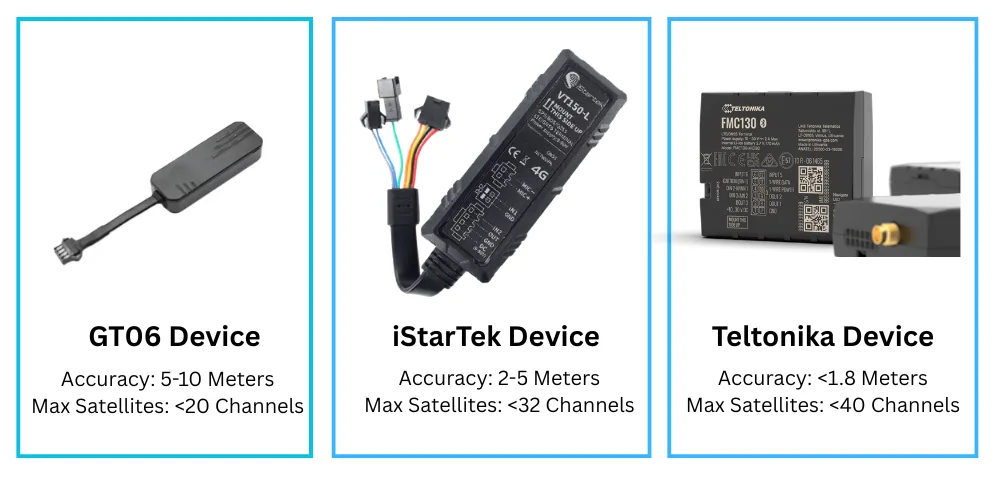
This part is where most buyers get confused. Two devices can look identical from outside and have very different prices because the chip inside, the firmware, and the platform supporting them are different. The honest reasons price goes up:
- Satellite channels. A 15-channel receiver loses signal in hills. A 72-channel module holds lock even under tree cover.
- GPS accuracy. Cheap units claim 5 to 10 metres. Quality units hit 2.5 metres consistently.
- Data retention. Some platforms keep 30 days of history. Others keep five years. Big difference when you need playback for an insurance claim.
- Backup battery. 4 hours, 8 hours, or 24 hours of independent operation. The longer the battery, the higher the cost.
- Driver behaviour analytics. Harsh braking, rapid acceleration, idling. Adds firmware and processing cost.
- Sensor support. Fuel sensors, RFID, temperature probes, dashcam streams. Each adds hardware sockets and software work.
- Firmware updates. Enterprise units get OTA (Over-The-Air) updates for years. Cheap ones get shipped and forgotten.
If you only ever check location once a day, you do not need premium. If you run a 30-truck logistics fleet across the major highways of Nepal, the difference between mid-tier and premium pays for itself in fuel savings within months.
Annual subscription, and what it actually pays for
Some buyers see "annual fee" and feel cheated. Here is what it actually covers:
- Cellular data charges for the SIM inside the device, every minute, every day
- Server infrastructure that listens to your tracker 24 hours a day
- Mobile and web app updates as Android and iOS evolve
- Local support staff who answer when something breaks
- Backups, redundancy, and uptime guarantees
Industry norm in Nepal is NPR 1,500 to NPR 4,000 per year, sometimes higher for enterprise fleets. A few providers bundle the first year into the device price so the up-front number looks complete. NepTrack uses this bundled model on its pricing page because we think buyers deserve one transparent number, not a two-line invoice trick.
Installation cost in Nepal
This is the most common surprise. Some vendors quote a low device price and then quietly add NPR 1,500 to NPR 3,000 for installation at the point of payment. Others include it free.
NepTrack installation is completely free across all of Nepal, from Kathmandu Valley to Pokhara, Birgunj, Butwal, Biratnagar, and every district in between. There is no travel surcharge, no remote-location fee, and no hidden installation cost added at the end. A bike install takes around 15 minutes. A car, bus, or truck takes about 30 minutes for a standard tracker install, and up to one hour if a fuel sensor is being added at the same time.
Self-installation is technically possible for two-wheelers, but doing so usually voids the warranty and can mask theft attempts because the wiring is in plain sight. We do not recommend it.
Hidden fees that show up later
The bill rarely matches the quote. Here is what tends to appear in the fine print:
- SIM card fee, charged separately by some providers even though the device is useless without one
- Activation or setup fee, framed as a one-time platform onboarding cost
- Re-installation fee when you sell the vehicle and want to move the device
- Cancellation penalty if you stop service mid-year
- Data overage charges on cheap plans with low usage caps
- Map license fees on a few legacy platforms still using paid map tiles
None of these are universal, but enough providers charge them that you should ask directly before signing.
What the very cheap trackers actually cost you
You can find GPS trackers on certain Nepali e-commerce sites for NPR 1,800 to NPR 3,000. They look the same in photos. They are not the same product.
The cheapest units use 2G modules. Nepal Telecom and Ncell have been quietly reducing 2G coverage. A 2G-only device sold today may stop working entirely within two to three years in some regions. There is no Nepali mobile app behind them, no local support number, and no warranty path beyond returning the box.
For a personal bike where you check the location twice a week, this might be acceptable. For anything commercial, it is a false economy.
DoTM compliance and how it affects price
As of 2026, the Department of Transport Management has not yet published specific technical standards for GPS tracking hardware. There is no official certification list, no mandatory feature checklist, and no formal device approval process in place today.
That said, DoTM is actively drafting a framework, and discussions around mandatory GPS for public service vehicles have been gaining ground. When those standards arrive, devices that already follow internationally accepted norms (enterprise-grade chipsets, standard reporting protocols, long-term data retention) will be far easier to bring into compliance than bottom-tier 2G units sold on e-commerce sites.
If you are buying a tracker today for a commercial vehicle, the safer position is to assume future regulation and choose hardware that will not need to be replaced when the rules are finalised. Read our full breakdown on DoTM GPS compliance for what is known so far and what to watch for.
What to budget based on what you actually own
Based on what NepTrack offers and what most operators in Nepal actually need:
- Bike or scooter owner: NPR 4,500 to 6,000 is enough. You mostly need location and anti-theft.
- Private car: NPR 8,500 is the sweet spot. Driver behaviour, fuel cut-off, and 3-month history are worth the extra cost.
- Small fleet, 2 to 10 vehicles: NPR 8,500 to 15,000 per vehicle, depending on whether you need fuel monitoring.
- Large fleet or government: NPR 15,000+ with full enterprise feature set. Volume discounts usually apply above 20 units.
Three-year cost of ownership
Hardware price is what people compare. Three-year cost is what actually matters. A rough comparison for a single car:
| Tier | Device + Year 1 | Year 2 + 3 | 3-Year Total |
|---|---|---|---|
| Entry (bundled) | NPR 4,500 | NPR 3,000 | NPR 7,500 |
| Professional (bundled) | NPR 8,500 | NPR 5,000 | NPR 13,500 |
| Enterprise (bundled) | NPR 15,000 | NPR 8,000 | NPR 23,000 |
Cheap trackers often look NPR 4,000 cheaper up front and end up costing more over three years because of replacement, lost data, and downtime.
A simple way to choose
Run through this short checklist before paying anyone:
- What vehicle is it for, and is it commercial?
- Do I need enterprise-grade or European-standard hardware?
- How long do I need history retained?
- Do I need driver behaviour analytics or just location?
- How many vehicles will I add in the next year?
- Do I need an open API for integration with my existing software?
- What is the local support contact, and what are their hours?
If a vendor cannot answer all seven clearly, that is a price signal in itself.
NepTrack compared with most GPS providers in Nepal
Now that you have seen the full range of prices, hidden fees, and feature differences, here is how NepTrack actually compares with what most providers in Nepal currently offer. The table is based on publicly available pricing and feature information from local GPS providers.
| Feature | NepTrack | Most Nepal Providers |
|---|---|---|
| Starting price | NPR 4,500 | NPR 7,500 to 9,000 |
| First year service | Bundled in price | Billed separately |
| Installation | Free, anywhere in Nepal | NPR 1,500 to 3,000 extra |
| Travel charge outside Valley | None | Often added |
| Data history retention | Up to 5 years | 30 to 90 days |
| Mobile app | Native Android and iOS | Often web only or basic |
| Multi-protocol device support | 10+ GPS protocols | Single vendor lock-in |
| Open API | Yes, free for customers | Rarely available |
| Developer SDKs | Apache 2.0 open source | None |
| Ready for future DoTM rules | Yes, all tiers | Varies, often only premium |
| Bikram Sambat dates | Built-in across platform | Gregorian only |
| Support language | Nepali, English, and Hindi | Mixed, often outsourced |
| Local support hours | 7 days, Nepal time | Office hours only |
| Driver behaviour analytics | Standard from mid-tier | Premium add-on |
| Hidden activation or SIM fee | None | Sometimes added |
| Cancel anytime | Yes, no penalty | Often locked-in contract |
The pattern is consistent. NepTrack starts lower, bundles more into the headline price, and removes the small fees that quietly add up elsewhere.
Why NepTrack pricing is structured the way it is
We made three deliberate choices that affect what we charge:
- One transparent up-front number with the first year of service included, so customers do not get a second invoice they were not expecting
- Free installation everywhere in Nepal, with no remote-location surcharge
- Five years of data retention on all plans, not just enterprise
- Open API and Apache 2.0 SDKs so no business is ever locked in
- Local support in Nepali, English, and Hindi, not a foreign call centre
The full hardware breakdown is on the hardware page, and the per-tier features are on the pricing page. For larger or sector-specific needs, the B2B solutions page covers fleet, government, logistics, and security deployments.
Frequently asked questions
Is there a monthly fee for GPS tracking in Nepal?
Some providers charge monthly, others annually. NepTrack uses an annual model with the first year bundled into the device price, so there is no separate first-year subscription bill.
Do I have to pay for the SIM card separately?
With NepTrack, no. The SIM and the data plan are included. Some other vendors do charge separately, so always confirm.
How much does GPS installation cost in Nepal?
With NepTrack, installation is completely free anywhere in Nepal. There is no travel charge, no remote-area fee, and no surprise installation cost at the end.
Is a GPS tracker mandatory for commercial vehicles?
Not yet. DoTM has not finalised mandatory GPS rules or device standards as of 2026, but a framework is being drafted. The smart move is to install hardware that will already meet future requirements rather than buying a cheap device that may need replacement.
What is the cheapest GPS tracker in Nepal that actually works?
NepTrack's entry tier starts at NPR 4,500 for two-wheelers and includes the first year of service. Anything significantly cheaper is usually a 2G-only device with no app and no support.
Can I install the GPS tracker myself?
Technically yes for bikes. Practically no, because self-installation often voids the warranty and makes the unit easier for thieves to find and disable.
The honest summary
GPS tracker prices in Nepal range from genuinely cheap and risky to fairly priced and reliable. The difference is rarely in the plastic case. It is in the chipset inside, the platform behind it, and whether anyone will pick up the phone when something goes wrong.
For most buyers, NPR 8,500 buys a GPS tracker that you will not need to think about again for years. That, more than anything, is what you are really paying for.
If you want a clear quote based on your vehicle type and fleet size, get in touch through the contact page or check our full FAQ.