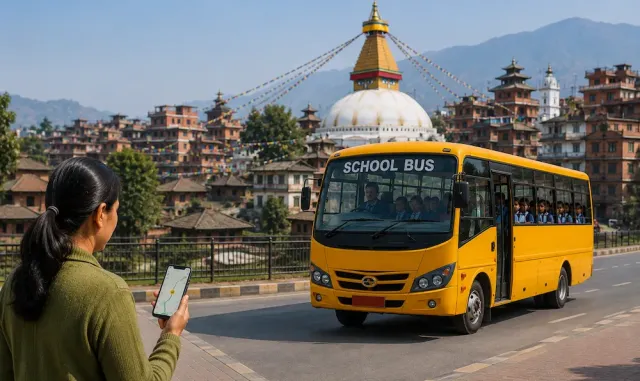
Every morning across Nepal, parents prepare their children for school based on a single piece of information: the time the bus is supposed to arrive. If the bus usually comes at 7:10, the child is dressed by 7:00 and standing at the gate by 7:08. That is the entire system. Most parents have no way to know if the bus is running on time, stuck in Kathmandu traffic, taking a different route, or already left the area.
When the bus is late, parents wait at the gate with their child, sometimes in cold weather, sometimes in rain, often without knowing whether the bus is two minutes away or has skipped the route entirely. A phone call to the school office usually returns the same answer: the office does not know either. The driver is unreachable while driving. Everyone is operating blind, every morning.
This is the gap that modern school bus systems close. Once GPS tracking and a parent app are in place, the question "where is the bus" stops requiring a phone call. Parents see the bus on a live map. They get notified when it is five minutes from their stop. They send the child out at the right moment, not too early, not too late. The change is small in technology but large in daily life.
This guide is for school administrators and transport in-charges who want to make their buses genuinely safer and trackable by parents in real time. We start with practical steps any school can take, then explain how a modern GPS tracking system fits in, what it costs, and what to look for before signing up.
Five things every Nepali school can do this term to improve bus safety
Before discussing technology, here are five operational steps any school can take, often within the same academic term, to make bus transport safer:
- Assign one transport in-charge with real authority. Not the principal's secretary doing it as a side task. Someone whose primary job is buses, drivers, routes, and parent communication. Most safety failures trace back to nobody being clearly responsible.
- Build a written route and stop map. Every route, every stop, every assigned child, every parent contact, kept in one document the office can pull up in 30 seconds. Most schools rely on the driver's memory, which fails on the day a substitute driver takes over.
- Set a clear pickup and drop window for each stop. If the bus is supposed to reach a stop between 7:05 and 7:10, parents and drivers both know. Anything outside that window triggers a phone call. This single discipline removes most parent-school conflicts about timing.
- Train drivers on harsh braking, idling, and turning. Bus drivers in Nepal rarely receive any formal driving review after they are hired. A 30-minute monthly conversation with the transport in-charge, based on real data, changes behaviour fast.
- Install GPS tracking with a parent-facing app. This is the modern enabler that makes the previous four steps actually work at scale. It also adds emergency response, route history, and audit-ready records that schools increasingly need.
The first four steps are organisational. The fifth is technical, and it is what the rest of this article focuses on, because it is where most schools either save money smartly or waste it badly.
What GPS tracking with parent access actually does
A GPS device is installed inside each bus. It records the bus location every few seconds and sends that data to a server hosted in Nepal. The server feeds three things at once:
- A parent app on Android and iOS where each parent sees only their own child's bus on a live map
- An institutional dashboard for the school transport in-charge to monitor every bus at once
- An alert engine that sends notifications for stop approach, route deviation, harsh driving, and SOS events
What makes the difference between a basic and a useful system is everything around that core: route management, stop-by-stop ETA, parent notifications, driver behaviour reports, and safety alerts. Without these, a tracker is just a moving dot on a map.
What parents specifically need from the system
Parents do not need a fleet management dashboard. They need three things, fast and reliable:
- Live location on a phone, ideally with a map view that updates in real time
- Notification when the bus is approaching their stop, so the child does not stand outside in cold or heat unnecessarily
- Confirmation that the child boarded and got off, either through RFID cards or a small driver action in the app
A few extras help: a shared route view for both parents, alerts when the bus deviates from its expected path, and a clear historical view for any parent who wants to verify a specific day. NepTrack provides all of these by default on the school bus tracking page.
The features that matter to schools
School administrators need a different set of capabilities:
- Real-time visibility over every bus in the fleet, not just one at a time
- Driver behaviour monitoring for harsh braking, rapid acceleration, and idling, so schools can take action before an incident happens
- Trip history retained for at least one full academic year so any parent complaint or safety review can be investigated
- Route optimisation to reduce fuel cost and journey time
- Centralised admin panel so the transport in-charge can see every bus on a single screen, instead of juggling separate phone calls, driver WhatsApp groups, and parent enquiries for each route
This last point is where many cheap GPS solutions fall apart. They focus only on the parent side, giving each parent a basic map view of one bus, and skip the school operations side entirely. There is no admin dashboard for the transport in-charge, no driver behaviour reports, no fleet-wide alerts. A school running 10 buses for 600 students cannot manage operations from a consumer-grade parent app.
What does school bus GPS tracking cost in Nepal
The honest range for 2026, based on what schools across Nepal are actually paying:
| Fleet size | Per-bus device cost | Annual subscription | Notes |
|---|---|---|---|
| 2 to 5 buses | NPR 10,000 to 15,000 | Bundled first year | Small private schools |
| 6 to 15 buses | NPR 10,000 to 15,000 | Volume discount typical | Most international schools fall here |
| 16+ buses | Custom enterprise quote | Often discounted | Large school chains, hostels with transport |
NepTrack installation is completely free anywhere in Nepal, with no remote-area surcharge. Full pricing details are on the pricing page, and a broader 2026 cost breakdown is in our GPS tracker pricing guide.
What schools should look for before signing up
Procurement decisions are often made under time pressure, and that is exactly when bad systems get chosen. Use this checklist before signing a contract:
- Does the provider have a real institutional dashboard? Ask to see a live demo with multiple buses, not just one tracker.
- Is there a parent app available on both Android and iOS? Not just a web link sent over WhatsApp.
- How long is trip history retained? Less than one academic year is not enough.
- What is the GPS accuracy? Ask for the exact specification. Quality devices report 2.5 metre accuracy with 33 to 72 satellite channels. Cheap devices claim 5 to 10 metres and lose lock in hills, alleyways, and dense traffic.
- Is the data hosted in Nepal? Important for compliance and audit requirements when future government regulations arrive.
- Does the system support Bikram Sambat dates? Important for school office paperwork and parent reports.
- Is local support available in Nepali? Not an outsourced foreign call centre.
- Can the school cancel anytime? Avoid long-term lock-in contracts.
- Are SDKs and an open API available? If your school already runs its own app or website for parents, the GPS provider should offer SDKs and an open API so bus tracking can be integrated directly into your existing platform. Schools without an existing app can use the provider's ready-made parent app instead. See NepTrack's developer documentation for what proper SDK and API access looks like.
If a vendor cannot answer all nine clearly, that is a procurement signal in itself.
The driver behaviour question
A GPS tracker on a school bus is incomplete without driver behaviour monitoring. Three patterns matter most:
- Harsh braking, which usually means following too closely or speeding into traffic
- Rapid acceleration, which wastes fuel and unsettles children
- Idling time, which wastes fuel and increases pollution near school gates
NepTrack provides automatic driver behaviour scoring out of the box. Schools can review weekly reports and take corrective action with drivers before a small habit becomes a safety incident.
Privacy and child safety
Parents often ask one question that no GPS provider mentions in their marketing: who else can see where my child is going?
This matters. A school bus tracking system should:
- Show parents only their own child's bus, never another route they have no business knowing
- Restrict driver location data to authorised school staff
- Encrypt all location traffic between device and server
- Never sell or share location data with third parties
- Maintain immutable audit logs of who accessed what
NepTrack follows all of these by default. Privacy is not an extra feature, it is the baseline.
SOS and emergency response
Beyond daily tracking, schools should ask what happens in a genuine emergency. The right answers:
- An SOS button on the device, accessible to the driver and bus assistant
- Automatic collision detection, which raises an alert if the bus experiences a sudden impact
- Direct alert to school office and parents within seconds, not minutes
- Escalation to higher authority if the school office does not acknowledge within the response window
NepTrack's SOS Emergency Response covers all four. Most consumer-grade trackers cover none.
Common mistakes schools make
Patterns we see repeatedly:
- Buying the cheapest tracker on the assumption that all GPS units are the same. They are not. Cheap devices typically have low-channel GPS receivers with 5 to 10 metre accuracy, fail to hold lock under tree cover or inside narrow Kathmandu lanes, and report positions infrequently. Quality units use 33 to 72 channel receivers with 2.5 metre accuracy, hold lock in hills and dense areas, and update every few seconds. On a school bus carrying children, the difference between a position pin landing on the right gate or on the wrong street matters.
- Skipping the parent app to save money. The whole point of school GPS tracking is parent communication. Without an app, schools end up answering phone calls all day.
- Ignoring driver behaviour reports for the first few months, then being surprised when an incident happens.
- Letting the contract lapse on subscription, only to find the tracker still working but with no support when something breaks.
- Self-installing trackers on a few buses, which voids warranties and leaves wiring exposed for drivers to disconnect.
What a good rollout looks like
For a school deploying GPS tracking for the first time:
- Week 1: Vendor meets with school transport in-charge to map routes, stops, and student-bus assignments.
- Week 2: Devices installed across the entire fleet, free of cost. Each install takes 30 to 60 minutes per bus.
- Week 3: Parent app rollout. Onboarding session with parents, ideally during a parent meeting day. Each parent gets installation help if needed.
- Week 4: First weekly driver behaviour report reviewed by transport in-charge. Adjustments made if any patterns emerge.
- Ongoing: Monthly review with vendor. Quarterly check on any feature requests from school staff.
A good vendor does not disappear after installation. They train, follow up, and adjust as the school's needs change.
Why we built school bus tracking the way we did
NepTrack's school bus tracking grew out of one observation: most GPS providers in Nepal sell trackers to fleet operators and treat school buses as a side category. We did the opposite. We built the school bus solution from the parent and school perspective first, then added the institutional dashboard on top.
That meant native Bikram Sambat dates across the entire platform, Nepali language support throughout, free installation across all of Nepal including remote areas, 5 year trip history retention, and a parent app that does one thing extremely well rather than a hundred things badly.
Compare detailed features on the school bus tracking page, or talk to us through the contact form for a no-pressure conversation about what your school needs.
Frequently asked questions
Is GPS tracking mandatory for school buses in Nepal?
Long-distance public buses already have a mandatory GPS requirement as of January 2026. School buses are not yet explicitly mandated, but the Department of Transport Management's draft guidelines (Guidelines on Making Public Transport Technology-Equipped, Healthy, Safe, Dignified and Passenger-Friendly, 2026) propose making GPS and CCTV mandatory across all public transport. The draft has been forwarded to the Ministry of Physical Infrastructure and Transport for approval. Once approved, school buses are very likely to fall under this requirement. Most reputable schools are already installing GPS voluntarily ahead of the rule, partly because parents expect it and partly to avoid a rushed compliance scramble later.
How much does it cost to track one school bus?
NepTrack school bus tracking starts at NPR 10,000 to 15,000 per bus including the first year of service. Volume discounts apply for fleets of six or more buses. Installation is completely free anywhere in Nepal.
Can parents see only their own child's bus?
Yes. NepTrack restricts parent app access to only the bus that their child is assigned to. Parents cannot see other routes or other children's locations.
What if the bus driver disconnects the GPS device?
NepTrack devices send a power-cut alert the moment they lose power. The school transport in-charge is notified immediately. The device also has internal battery backup, so it keeps reporting for several hours even after disconnection.
Does it work in remote areas outside Kathmandu Valley?
Yes. NepTrack devices use multi-protocol GPS with LBS fallback for areas with weak GPS signal, common in Nepal's hill regions. Installation is provided free anywhere in Nepal.
What happens during a network outage?
Devices store position data locally and transmit it once connectivity is restored. No data is lost during temporary outages.
How long is trip history retained?
NepTrack retains full trip history for up to 5 years. This is significantly longer than most providers, which keep only 30 to 90 days.
The honest summary
School bus GPS tracking in Nepal in 2026 is not a luxury. It is a baseline expectation for parents and a basic operational tool for schools. The technology has matured, the prices have stabilised, and the difference between a good system and a bad one is no longer about features, it is about discipline, support, and treating parents and schools as the actual users.
NepTrack starts at NPR 10,000 to 15,000 per bus with the first year of service bundled in. Free installation across Nepal. Native parent app on Android and iOS. Full Bikram Sambat support. Local Nepali support team. That is what we offer, and we are happy to walk any school through a demo before any commitment is made.
If you are a parent whose school does not yet have GPS tracking, share this guide with the school administration. If you are a school administrator evaluating options, use the eight-point checklist above and request demos from at least two providers before deciding. Bad choices in school transport are expensive to undo.
Reach us through the contact page or check our full FAQ for more details.